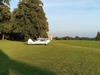
Manchester Barton on Monday. Cessna a write off. That’s a lot of paperwork…
I feel for the guy trying to hold his plane – it could have been me – but it would have probably been smarter to run at this stage. Not only the plane crushing him but mostly the fuel in combination with some sparks scare me.
Are there some rules of thumb concerning the distance you should keep with the helicopter from fixed wing? I assume this would depend on the mass and the altitude.
So, realistically speaking, what will the insurer do?
Try every trick in the book to avoid paying, I expect. It’s what they usually do. (In fairness, mine didn’t – they took one look at the pictures and paid up without even sending an assessor).
Anyway the plane was at the fuel pumps, it’s hard to argue that he shouldn’t have been there. It was the heli pilot who was at fault but since they’re military, don’t expect much.
Chinooks have serious downwash – one landed at my school and it peeled off a building like a sardine tin lid.
An instructor I know at this airfield said it will be up to the airfield (and their insurance) to pay out, as it’s a FISO service so they control the ground situation
IO390 wrote:
An instructor I know at this airfield said it will be up to the airfield (and their insurance) to pay out, as it’s a FISO service so they control the ground situation
The Chinook is not on the ground :-)
What stunning incompetence all round. It’s hard to imagine a world in which it wasn’t made clear to them that they should land / depart in the very middle of the grass space absolutely miles away from anything…
This is one of those things that always keep coming back as a terror thing. ENOP is used a lot for helicopter refueling. When parked close to the pump and a Sea King was approaching, this was always a heart jumping startling event  Today they use the AW with twice the downwash. I have never yet met one of those at ENOP, but it will for sure blow away everything. Even the small Jet Ranger I met last weekend had a scaringly downwash if close enough to a 300 kg empty weight aircraft.
Incidents doesn’t happen too often though, the pilots are normally well aware of this downwash. Much more incidents have happened with 737 size aircraft blowing away small GA.
At KCLW in 2008/2009, there was an R44 in the hover, either on the parallel taxiway or a parking spot (can’t remember which), 150’ or 260’ away from the runway centreline respectively. A landing C172 encountered the downwash, had some wild porpoising in the flare, then did a go-around.
My instructor was very scathing about the Cessna pilot: he should have anticipated the wind shear and either gone around earlier, or landed long. I was surprised as I’d never encountered or even thought about this before. My French PPL covered wake turbulence in both the theory book and practical training, but zero about helicopters.
Another instructor said they saw a UH-60 at KPIE go over a port-a-potty at low level. It went flying and landed 50’ away, and whilst a funny story, can’t have been very pleasant for the construction worker inside at the time. Similar example on Youtube (10s-25s):
Surely initial helicopter training must cover basic situational awareness in the hover? I had a few lessons in an R22, where the instructor described the toroid of recirculated air. Maybe, as military, they are used to a more ‘sterile’ environment than a civilian airport. Or the cavalier attitude that ground matters (maintenance, the immediate environment) are someone else’s problem.
I assume the easiest solution it to claim on one’s own insurance, who then may or may not pursue other parties at fault. Looks like there’s a government department tasked solely with these types of claims: CLC&P.
At Palo Alto we were forbidden to hover-taxi along the taxiways, for this reason, Meant all our takeoffs were max performance (vertical climb to 30 feet or so) which adds a certain frisson since if the engine stops it will really not work out well.
I have witnessed this happen. All be it a smaller helicopter (AS350), but three Cessnas damaged. I ran to try to grab one, but could not get there fast enough. The insurer will pay out the airplane, then seek repayment from the military, who have zero grounds to evade paying. This is indefensible on the part of the pilot. If the helicopter operation was so mission critical that it was worth sacrificing a Cessna, then they can pay for it!
Many years ago I was on a helicopter solo cross country to the helipads of an airport I knew very well (as a fixed wing pilot). I was cleared to land on a pad between two parked R-44’s. I observed that their rotors were not tied. I had no way to communicate with the people on the apron for the helipads, other than to hold off and hover away over the (non landable) grass. Eventually, someone paid enough attention to realize why I was hovering off for several minutes, and tied the rotors. Then I hovered in and landed. No doubt that no damage had been done from my rotor wash.
This careless operation of an aircraft is no different than propeller wash blowing over something (or blowing it into someone). Your operation is never more important than safety!